Feedback from our campus community is essential for guiding activities across the institution, and surveys are often an effective way to collect that information. In fall 2024, the Provost asked Vice Chancellors to appoint a representative from their division to join a new campus committee responsible for developing the infrastructure to review, approve, and coordinate institutional surveys. The goals of the Institutional Survey Review Committee (ISRC) include:
- Monitoring the volume of institutional surveys.
- Coordinating the timing of institutional surveys.
- Reducing redundant institutional surveys.
- Enhancing the quality of institutional survey data and increasing response rates.
To clarify, this new institutional survey review, approval, and coordination process is not meant to hinder academic research or interfere with the essential functions of the university, schools, colleges, divisions, or departments. Instead, it aims to ensure that campus surveys are focused, efficient, and designed to support meaningful operational impact.
This webpage has the following sections:
Pre-survey considerations
Before submitting your survey for review, please consider the following:
- Is this a survey? The committee reviews surveys, not forms. The availability of Qualtrics and other data collection tools can blur the line between them.
- A data collection activity is considered a survey when its primary purpose is to gather information from a group of people about their experiences, opinions, needs, behaviors, perceptions, satisfaction, or outcomes, and when the results will be summarized or used for assessment, planning, evaluation, reporting, research, or institutional decision-making.
- Forms used solely to complete an administrative transaction (e.g., registration, RSVP, intake, application, scheduling, service delivery, or compliance documentation) are not considered surveys unless they include nonessential assessment, feedback, opinion, climate, or evaluation questions.
- Is the information you want to collect already available? Are you searching for data in student or employee records? Is there another institutional survey that has already gathered or will gather the data you need? If you’re unsure whether the data you are looking for already exist, reach out to the ISRC committee with your questions.
- Is a survey the right method for collecting data? There are several common ways to gather information from students, faculty, and staff. Have you considered focus groups, listening sessions, or in-person interviews? Depending on what you want to achieve, these options might be more appropriate and efficient.
- Does your unit have the expertise and capacity to design, administer, analyze, and report survey results? There is a scientific basis behind survey design and administration, as well as the expertise needed to properly interpret survey responses and draw meaningful conclusions. There are resources on campus to help you, including the UW Survey Center (UWSC).
- Do you have clear goals and a plan for how you will use the results? What do you want to learn, about whom, and how will the survey results affect your unit’s operations? Is your leadership committed to using and sharing the results?
- How will you define your target population? You will need to identify the exact target population—such as all undergraduates, specific program graduate students, staff, division employees, or event participants—to determine who should be invited, ensure the right people are reached, and interpret results appropriately. A clear target helps compare respondents with the full population on characteristics like role, academic level, or demographics, to assess representativeness or potential biases. Without a defined target, it’s unclear what the results represent or if biases exist.
- How will you obtain contact information? Some surveys use predefined email lists to invite participants, but it is common that you will need to obtain and compile contact information to field your survey. When a list must be created, additional care is needed to ensure that the source of contact information is authorized, complete, accurate, and consistent with privacy, data governance, and institutional policies. Consult the Office of the Registrar and the Office of Human Resources for more information.
- Will you survey everyone or a subset? For large populations, random sampling is generally preferred when the goal is to estimate overall attitudes, experiences, behaviors, or needs. Sampling reduces respondent burden, limits survey fatigue, and, when designed appropriately, can produce high-quality evidence. Census surveys, in which all eligible people are invited, should be reserved for situations where broad participation is necessary, such as when results must be reported for small subgroups or units, when the population is small, when participation is part of the institutional process, or when external requirements call for inviting all eligible individuals. A census survey design does not, by itself, guarantee representative results; sponsors must still address response rates and nonresponse bias.
- How will you handle identifiable information? Transparency with potential survey participants about whether their responses could be identifiable is a critical element of informed consent. In practice, the terms Anonymous and Confidential are sometimes incorrectly used interchangeably.
- Anonymous means that no direct identifiers are collected, and the survey team cannot readily link responses to a person, either directly or through a code key or similar linkage.
- Confidential means the survey team knows who participated or could link responses to participants, but promises to limit access, protect the data, and not disclose identities except as described.
- Are you offering a survey incentive? Survey incentives can be an effective way to encourage participation, improve response rates, and thank respondents for their time. Incentives should be planned carefully and administered consistently. Any incentives offered must comply with applicable laws, regulations, and institutional policies, including UW System Administrative Policy 330: Prizes, Awards, and Gifts.
Institutional surveys requiring review, approval, and coordination
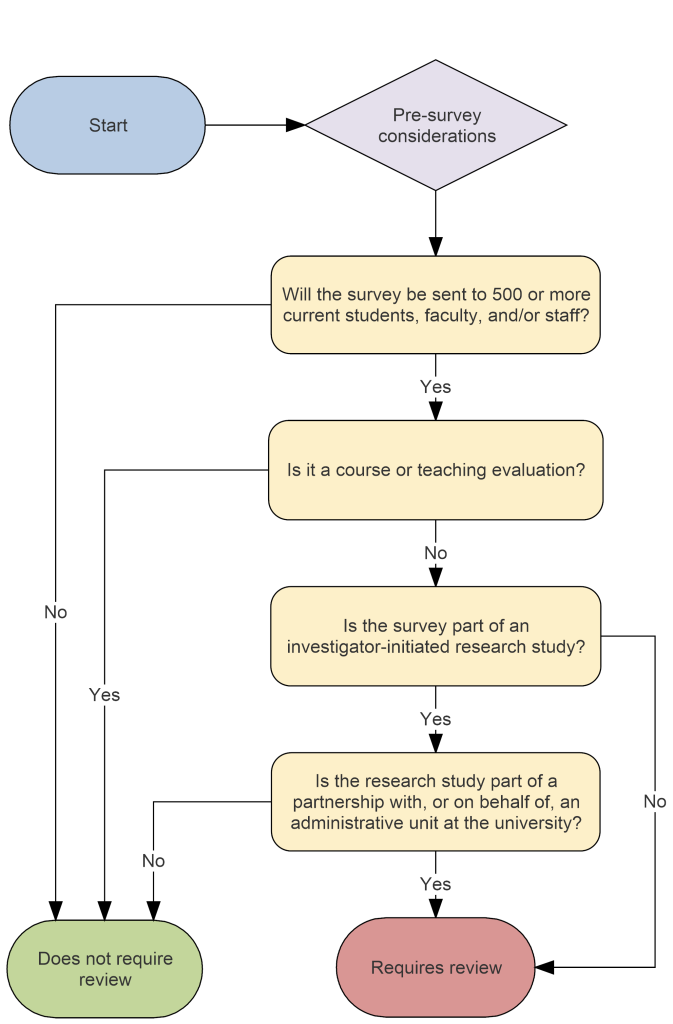
Institutional surveys of current students, faculty, or staff generally require review, approval, and coordination by the ISRC committee if they will be sent to 500 or more individuals.
However, the following types of institutional surveys are exempt:
- Alumni surveys.
- Course and teaching evaluations.
- Surveys solely for academic research, which are generally approved by the IRB.
If you are unsure whether your survey meets the criteria for exemption, please err on the side of caution and contact us at surveys@provost.wisc.edu.
The flowchart below can help you decide if you need to submit your survey for review, approval, and coordination.
Survey submission process and timeline
Once you have determined your survey meets the criteria for submission, you are ready to start the approval process.
- Review the survey calendar: Verify if other surveys will be conducted at the same time and consider modifying your plan as needed.
- Submit intake form: Submit your materials through the Qualtrics survey intake form. You will get an automated confirmation of your submission.
- Survey review: The Institutional Survey Review Committee will review your submission. The committee may ask for additional information or require modifications to your survey plan. You should receive a decision from the committee within two weeks, along with any additional instructions.
- Survey approved: Congratulations, your survey has been approved and added to the institutional survey calendar.
- Survey administration: Administer your survey following the approved protocol. Please notify the committee immediately of any changes to the approved protocol, a data breach, or a mental health crisis disclosed by a survey participant.
Submission form
Units must complete a Qualtrics form. A sample of the form is available for download.
Timeline to submit a request
If you are administering a survey in the:
- Fall semester: submit to the committee by July 15.
- Spring semester: submit to the committee by December 15.
- Summer semester: submit to the committee by April 15.
We understand that surveys often need to be fielded with shorter notification, and the committee will work with units to include their survey in the approval process.
Planned surveys
In addition to the planned surveys listed above, you may wish to consider the academic calendar, breaks and holidays, and contract year cycles when planning your survey. Please also consider several regular or ongoing student surveys:
- The Graduate School administers the Master’s Exit Survey, the Doctoral Exit Survey, and the Doctoral Student Experience Survey when a student’s degree or preliminary exam warrant is requested, which is usually near the end of each term.
- Undergraduate students completing a bachelor’s degree receive the First Destination Survey in the weeks before graduation, with reminders to complete or update their responses for six months after graduation.
- Course evaluation surveys typically occur during the final week of instruction each term.
Institutional Survey Review Committee
The committee provides a written report to leadership annually. Current members include:
- Data, Academic Planning & Institutional Research—Bethany Crowell and James Yonker.
- Division for Teaching and Learning—Regina Lowery.
- Division of Enrollment Management—Cori Splain.
- Division of Finance and Administration—Paul Seitz.
- Office of Human Resources—Lucien Gerondeau.
- Office of the Chancellor—Jennifer Noyes.
- Student Affairs—Ning Sun.
- University of Wisconsin Survey Center (UWSC)—Jennifer Dykema.